

Sequence of returns risk in pre-retirement and post-retirement are the danger that a market drop in the first few years before and after you stop working will do lasting harm to your income. We call this "The Retirement Red-Zone". 5 years prior to retirement and 5 years after. The same average return can leave you in two very different places depending on when the bad years hit. The way to prepare is structure, not prediction: build a protected income floor for your essentials, keep a separate growth layer for the long term, and decide in advance which accounts you draw from when markets fall.
What is sequence of returns risk in retirement?
While you are still working and saving, the order of market returns barely matters. You are adding money, not taking it out, so a down year is just a chance to buy more at lower prices. Retirement flips that. Once you start pulling cash out every month, a bad year early on can quietly reshape the rest of your plan.
Here is why. When the market falls and you still need to withdraw, say, $8,000 a month, you have to sell more shares to raise that cash. Those shares are gone. When the market recovers, you own fewer of them to recover with. A portfolio that drops 20% in your first retirement year while you are taking withdrawals can struggle to catch up even if the market posts a strong average return over the next decade.
Two retirees can earn the exact same average return over 20 years and end up with wildly different outcomes, the only difference being which years were good and which were bad.
- Sequence of returns risk
- The risk that the order in which investment returns happen (especially early losses while you are withdrawing money) permanently reduces how long your savings last.
- Withdrawal rate
- The percentage of your portfolio you take out each year for income.
- Bifurcated income plan
- A strategy that splits retirement income into two layers: one built for predictability and one built for growth.
Why does the order of returns matter? A sequence of returns risk chart
A simple comparison shows the problem. Imagine two retirees who each start with the same balance, take the same withdrawals, and earn the same average return over the years. The only difference is timing: one hits a rough patch early, the other hits it late.
The same ten returns, in two different orders
Two hypothetical portfolios. Both open at $2,000,000, both withdraw $8,000 a month, and both earn exactly the same ten annual returns, averaging 6% a year. Only the order changes.
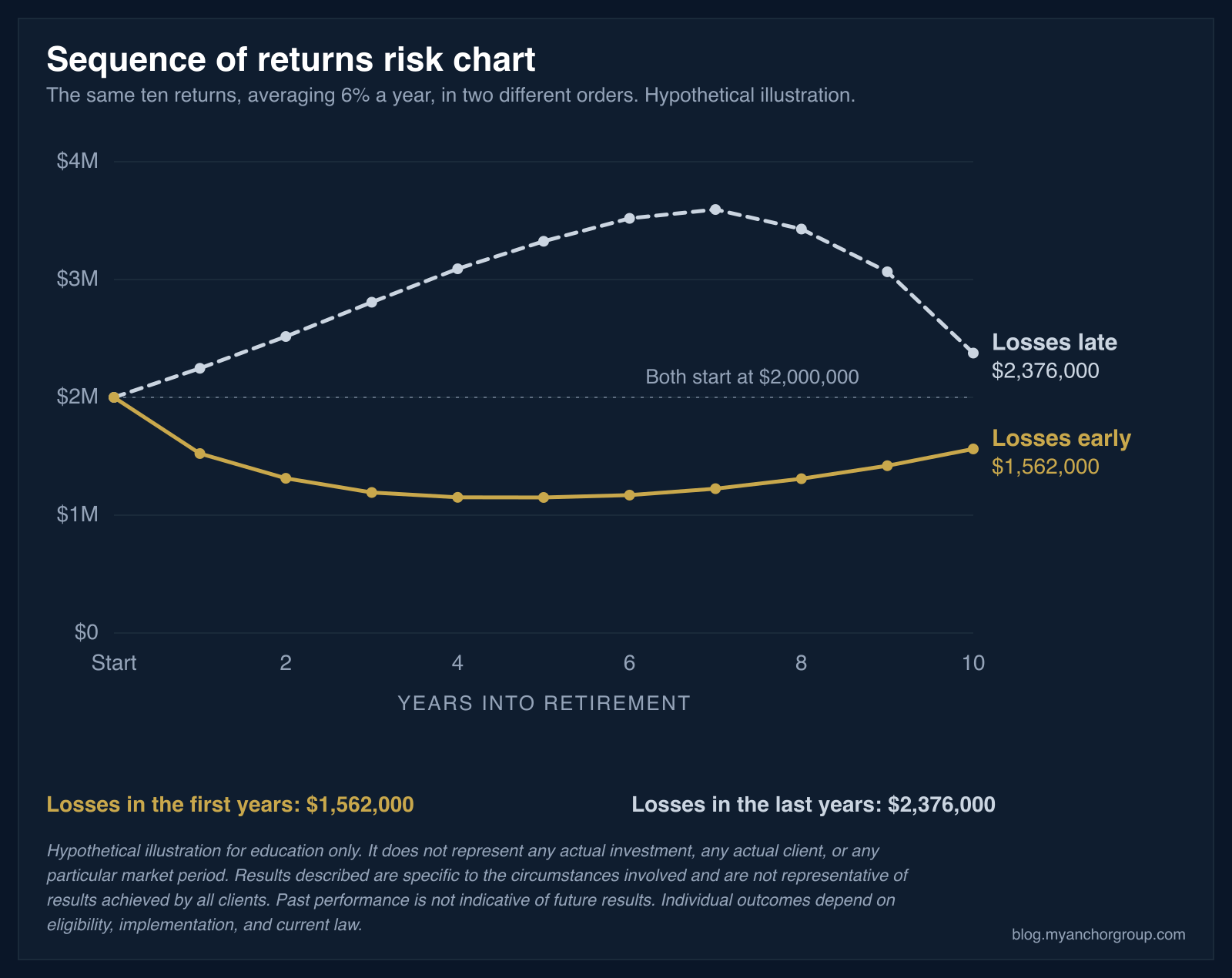
Returns applied in order: -20%, -8%, -2%, +5%, +9%, +11%, +14%, +16%, +17%, +18%. The second line uses that same list reversed, which leaves the average untouched. Withdrawals are taken at the start of each year and the year's return applied to what is left; balances are rounded to the nearest thousand. The first year's 20% drop and the $8,000 monthly withdrawal are the figures used earlier in this article; the opening balance and the remaining returns are illustrative and were chosen to show the effect, not to predict it.
Hypothetical illustration for education only. It does not represent any actual investment, any actual client, or any particular market period. Results described are specific to the circumstances involved and are not representative of results achieved by all clients. Past performance is not indicative of future results. Individual outcomes depend on eligibility, implementation, and current law.
| Scenario | When the bad years hit | Effect on the income plan |
|---|---|---|
| Early losses | First few years of retirement | Withdrawals are taken from a shrinking balance, locking in losses and reducing what is left to recover. |
| Late losses | Later in retirement | Years of growth happened first, so the portfolio absorbs the downturn from a stronger position. |
| Steady, average returns | No major early shock | The most stable outcome, but the real market rarely cooperates this neatly. |
Same math, very different results. That is the whole point of sequence of returns risk: you cannot control the order the market delivers returns, so a durable plan has to be built to survive a bad order, not just an average one.
How do you protect a retirement portfolio from market volatility?
You do not solve this by guessing when the next downturn arrives. You solve it by building a structure that does not force you to sell investments at the worst possible time. At Anchor, this is the idea behind the Precision Income Layer, a bifurcated approach that separates your income into two jobs.
Step 1: Separate your spending into essential and discretionary
Map out what your retirement actually costs. Essentials are the bills that must be paid no matter what the market does: housing, food, healthcare, insurance. Discretionary spending is travel, gifts, hobbies, the things you can flex in a down year. You cannot defend what you have not measured.
Step 2: Build a protected income floor for the essentials
The goal is to cover your non-negotiable expenses with income that does not depend on the market's mood each month. Some retirees build this floor using contractually backed instruments designed to deliver steady income. When essentials are covered by predictable income, a market drop becomes far less threatening, because you are not forced to sell falling assets to pay the light bill.
Guarantees are subject to the claims-paying ability of the issuing insurance carrier.
Step 3: Keep a growth layer for the long term
Your remaining assets stay invested for growth, inflation defense, and legacy. Because your essentials are already covered, this layer can stay invested through a downturn instead of being drained at the bottom. That gives it time, the one thing a recovering market needs most.
The point of a protected income floor is simple: never be forced to sell a falling asset to buy groceries.
Step 4: Decide your withdrawal order in advance
Which account do you draw from first: taxable, pre-tax, or Roth? In a down market, the order matters. A coordinated plan sets these rules ahead of time so decisions are made from a position of visibility, not panic. Drawing from the right bucket in the right order can also reduce unnecessary tax drag, which is its own form of protection. (For more on the tax side of withdrawals, see our guide on how to reduce taxes on IRA distributions and 401(k) withdrawals.)
Step 5: Stress-test the plan
Run your plan against a bad scenario: a sharp drop in year one, a long stretch of weak returns, an unexpected healthcare cost. If the plan only survives in good markets, it is not a plan. It is a hope. A coordinated strategy is designed to hold together under pressure, not just on a sunny day.
When is sequence of returns risk most dangerous?
The danger zone is the roughly ten years, (5 years on either side of your retirement date). This is the moment your portfolio is largest and your withdrawals are about to begin or have just begun. A serious downturn in this narrow window can do more lasting damage than the same downturn 15 years later.
That is also why the years before retirement deserve a hard look, not just the years after. Positioning assets, building the income floor, and coordinating taxes are decisions best made before you need the income, when you still have options. What got you to retirement is not always what gets you through the transition into it.
Because this risk sits where investments, income, and taxes overlap, it is hard to address with siloed advice. If your investment advisor never sees your tax picture and your CPA never looks at your withdrawal plan, the seam between them is exactly where sequence risk hides. A coordinated, fiduciary-led structure is built to close that seam. (This is why and how a multi-family office differs from a traditional financial advisor.)
Frequently asked questions
Is sequence of returns risk the same as market risk?
No. Market risk is the general chance that investments lose value. Sequence of returns risk is specifically about the order those gains and losses arrive, and how an early loss combined with withdrawals can do outsized, lasting harm to a retirement income plan.
Can I just wait out a downturn instead of selling?
You can if you do not need that money for living expenses. The trap is being forced to sell falling assets to pay essential bills. A protected income floor is designed to cover those essentials so your invested assets have time to recover instead of being drained at a low point.
Does having a lot of money make me immune to this risk?
Not automatically. A high net worth on paper does not guarantee predictable spendable income. Without a structure that protects essentials and coordinates withdrawals, even a large portfolio can face pressure if a major downturn hits early in retirement.
When should I start planning for sequence of returns risk?
Ideally in the five to ten years before your retirement date. Positioning assets, building an income floor, and coordinating taxes are far easier to do while you still have options and are not yet drawing income.
Does the order I withdraw from accounts affect this risk?
Yes. Drawing from the wrong account in a down year can lock in losses and create unnecessary tax drag. Coordinating your withdrawal order across taxable, pre-tax, and Roth accounts is part of defending against this risk. Your specific situation should be reviewed with your own tax professional.
Sources
This article is for educational purposes only and does not constitute financial, tax, or legal advice. Anchor Financial Group is a registered investment adviser; investing involves risk, including the possible loss of principal, and past performance does not guarantee future results. Consult a qualified advisor about your specific situation.